
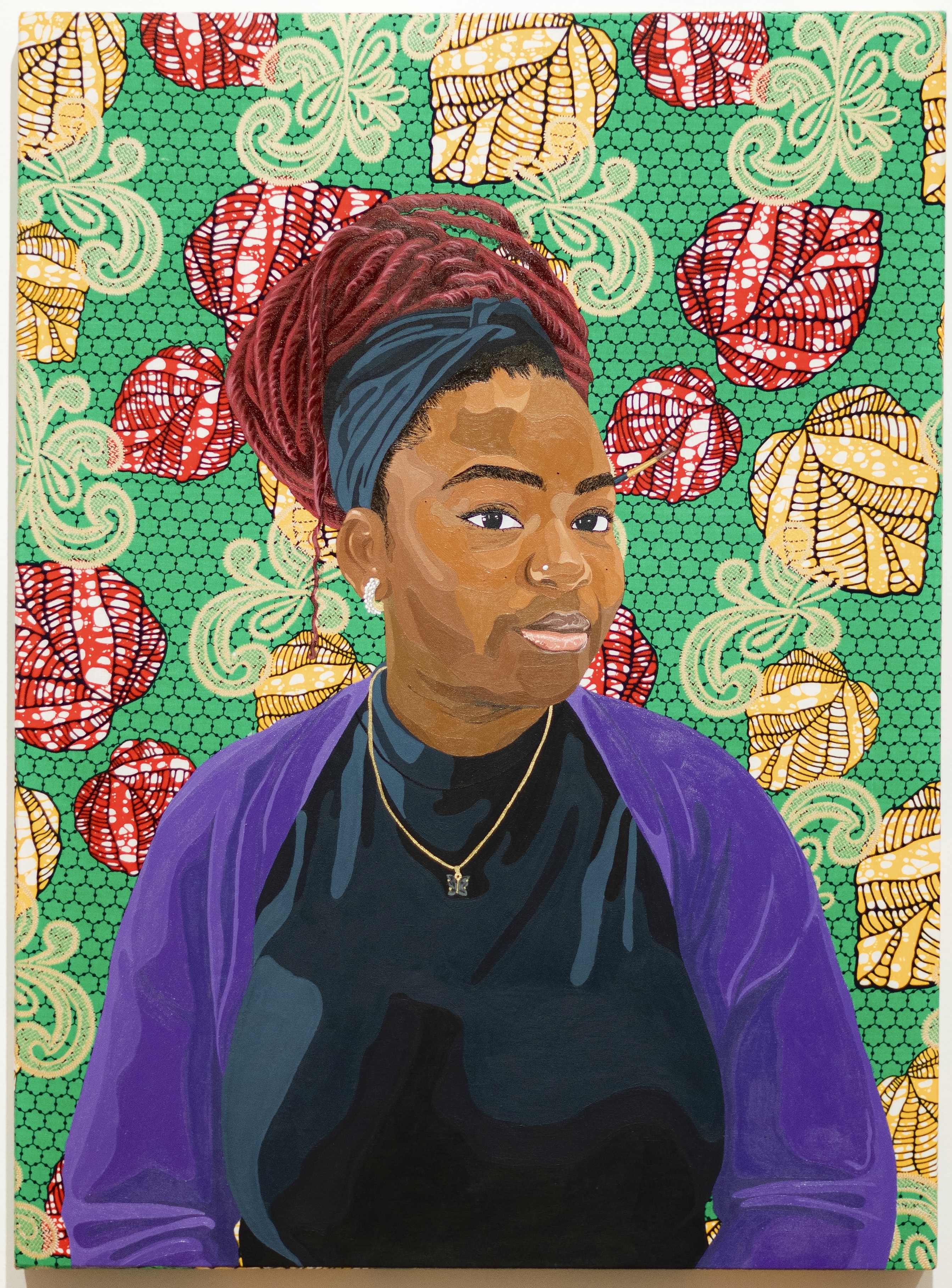
Hadiza Bello, Golden Age, Black Muse: Hadiza Jummai Bello (after “Uomo col turbante” by Jan van Eyck, 1433), 2025.
Acrylic paint on ankara fabric on wood panel, 30 × 22 × 2 in.
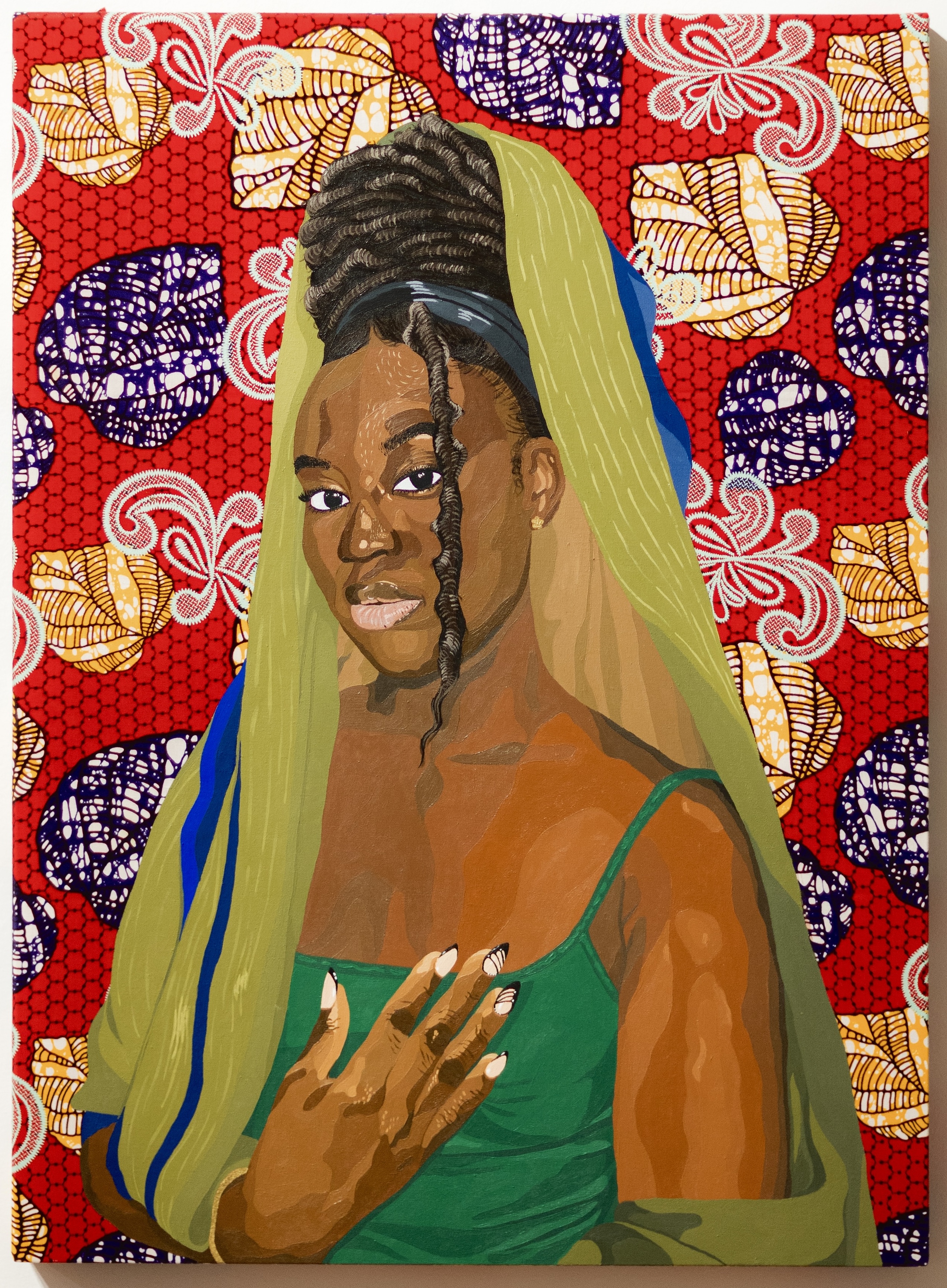
Hadiza Bello, Golden Age, Black Muse: Oluwatomilola Sharon Diane Joseph-Raji (after “La Donna Velata” by Raffaello Sanzio da Urbino, c. 1516), 2024.
Acrylic paint on ankara fabric on wood panel, 30 × 22 × 2 in.
As Eye Can
Regarding the paintings above—deliberately displayed before the text (without any suggestion or indication)—I suspect the eyes were noticed first. It’s a comfortable stare, carrying a poised awareness of things. A look that persists, regarding happenstance as relative and obstacles as ordinary. The subjects appear as they wish, unhurried and undefended. They don’t perform for the viewer; rather, they question and await your honest response. Then the background asserts itself through this recognition, a color choice not intended to recede politely into the background. It insists. It vibrates. And so the viewer’s eyes may be pulled from the subject, momentarily, before returning to the face, where the subject is not diminished by this detour; she is deepened by it. We then consider the composition, the three-quarter profile against a vivid Ankara fabric background—the same compositional pose as Van Eyck’s famous red-turbaned subject in “Portrait of a Man,” but entirely recast. The bold floral and botanical patterns of the Ankara fabric replace Van Eyck’s neutral background, infusing it with a cultural ethos. And we realize that a challenge is being posed to the fine art canon. These two pieces from Bello’s “Golden Age, Black Muse” series place Black women and their histories within the compositional aesthetic of Old Master portraiture.
The first image is a self-portrait titled Hadiza Jummai Bello (after “Uomo col Turbante” by Jan van Eyck, 1433). The original Van Eyck includes several elements scholars have interpreted as suggesting that the visage depicted is the artist himself — including the sitter’s dress, appropriate for a man of Van Eyck’s social status, and an inscription on the original frame reading “Als Ich Can” (“as I/Eyck can”), which art historians have interpreted as both a professional declaration and a pun on the artist’s name.1 The juxtaposition of Bello’s work adds an ironic layer of meaning that asserts an equal pursuit of ability and representation. The image serves as a reminder of class structures as much as of the institution of art. But are they so different? Bello’s work is about inclusion, but not solely inclusion, for that is too simple. Her work simultaneously functions as a new canon, a redirection from recognition, and an openness to ownership. The suggestion of a canon as something firm and finished is a suffocating prospect. Bello is breathing life into it.
The second piece in the series, Oluwatomilola Sharon Diane Joseph-Raji (after “La Donna Velata” by Raffaello Sanzio da Urbino, c. 1516), echoes Raphael’s veiled woman, except that the sitter meets the viewer’s gaze with a directness Raphael’s demure subject never quite achieves. The veil is replaced by a flowing olive-green-and-blue cloth draped over twists and braids. The subject has placed her hand on her chest. The refrain of the Ankara speaks of life, of an endless history deeper than we can imagine. It is a portal, a vivid memory of home that isn’t a weight she carries; it is an echo of a world she commands, for she is wilfully shaped by her choices.
Raphael’s Veiled Woman carries a charged history, long defined by what is withheld: the sitter’s unknown identity — though scholars have noted that her opulent silk gown and jewelry suggest a noblewoman, and some have argued she may not have been a real person at all, but rather a composite projection of Raphael’s idea of feminine perfection.2 That ambiguity is inseparable from a broader critical conversation about the painting: the subject functions as an erotic object and an idealized screen for the male gaze — her individuality dissolving into an abstract ideal of beauty.3 As if addressing that speculation, Bello paints Oluwatomilola Sharon Diane Joseph-Raji — a full name, a specific person, unambiguously present. Bello’s subject lives in a world where nothing is idealized into abstraction, and everything points to the particular. Her presence does not merely cite historical works; she interrogates them. From the perspective of cultural memory, represented as a visual surround, they ask: whose image has been considered worthy of preservation? Whose beauty has been deemed worth painting?
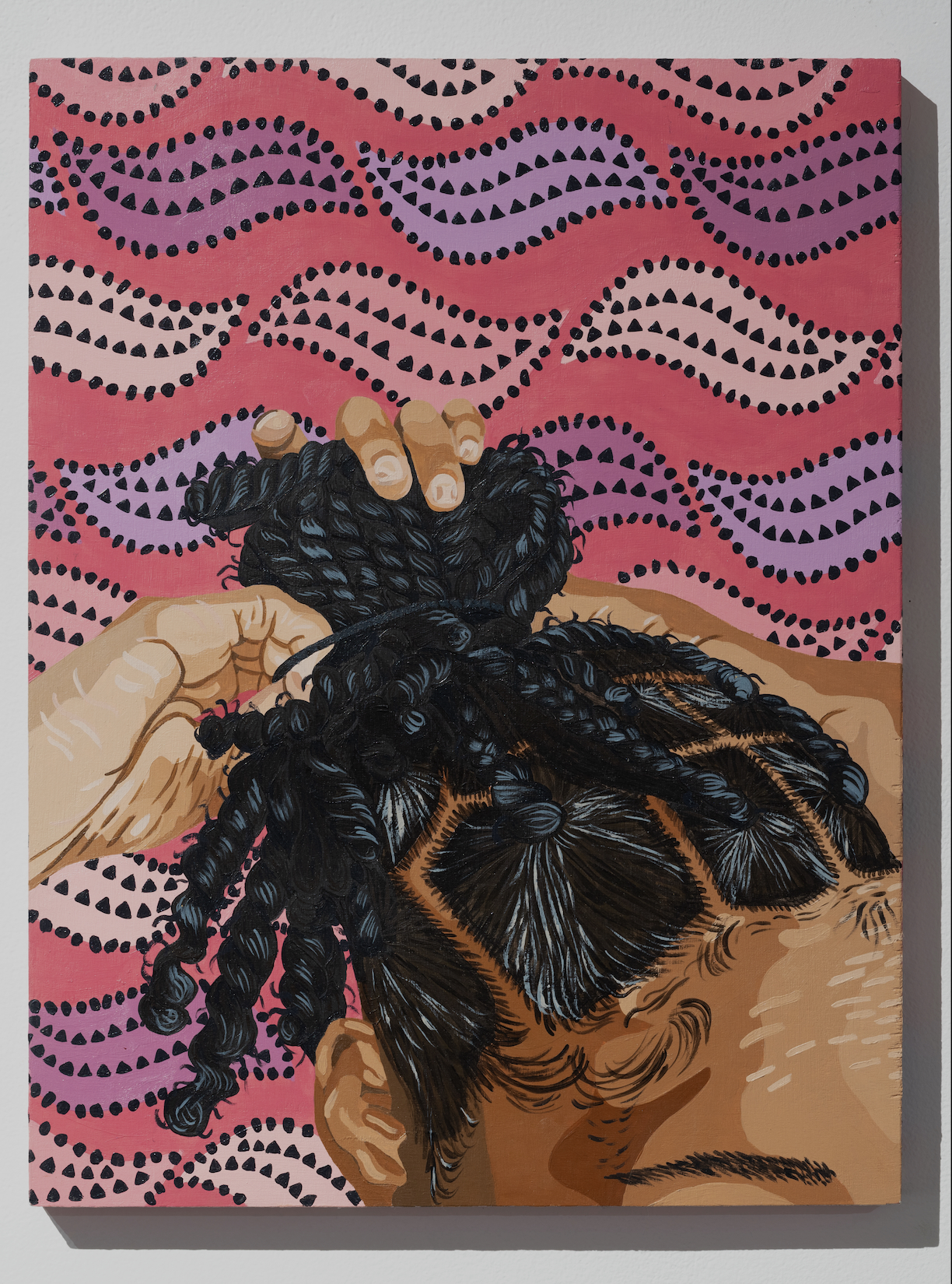
Hadiza Bello, Mo Maa Sajoyo / I Will Celebrate (2), 2023.
Acrylic paint on wood panel, 16 × 12 × 2 in.
Braided into History
The gesture of tying hair is not an empty task — it is a deliberate and tender staging. Mo Maa Sajoyo / I Will Celebrate (2) depicts the act of tying a mass of dark braids against a wavy pink-and-purple Ankara. A composition that celebrates self-worth through touch. The Yoruba title, which translates as “I Will Celebrate,” suggests a deeper meaning that extends beyond self-preparation. Black hair has been a contested political site across the African diaspora for centuries. As scholar Sylviane Ngandu-Kalenga Greensword has chronicled, hair has been weaponized to control Black women’s bodies across multiple periods of pan-American history — shaved as punishment during enslavement, advocated for concealment under Louisiana’s Tignon Laws of the late eighteenth century, and, in recent decades, subjected to workplace and school policies that position natural Black hairstyles as unprofessional, distracting, or noncompliant with institutional norms.4 Emma Tarlo, writing in the Journal of the Royal Anthropological Institute, has described Black hair styling as carrying “a highly complex historiography, shot through with narratives of pride and humiliation, liberation and oppression” — its intimate politics inseparable from histories of slavery, imperialism, and the persistent dominance of white beauty standards over definitions of femininity.5 Canada currently has no federal legislation equivalent to the American CROWN Act, which explicitly protects natural and protective hairstyles. This means Black workers in Canada who face discrimination for wearing braids or other natural styles must rely on broader race-discrimination frameworks to seek redress. Against this history, Mo Maa Sajoyo / I Will Celebrate does something quietly radical: it frames the act of wearing braided hair not as a problem to be managed but as its own form of declaration. She paints two hands at work and calls it a celebration. In doing so, she reminds us that to look — really look — at what has been made invisible is itself a political act.
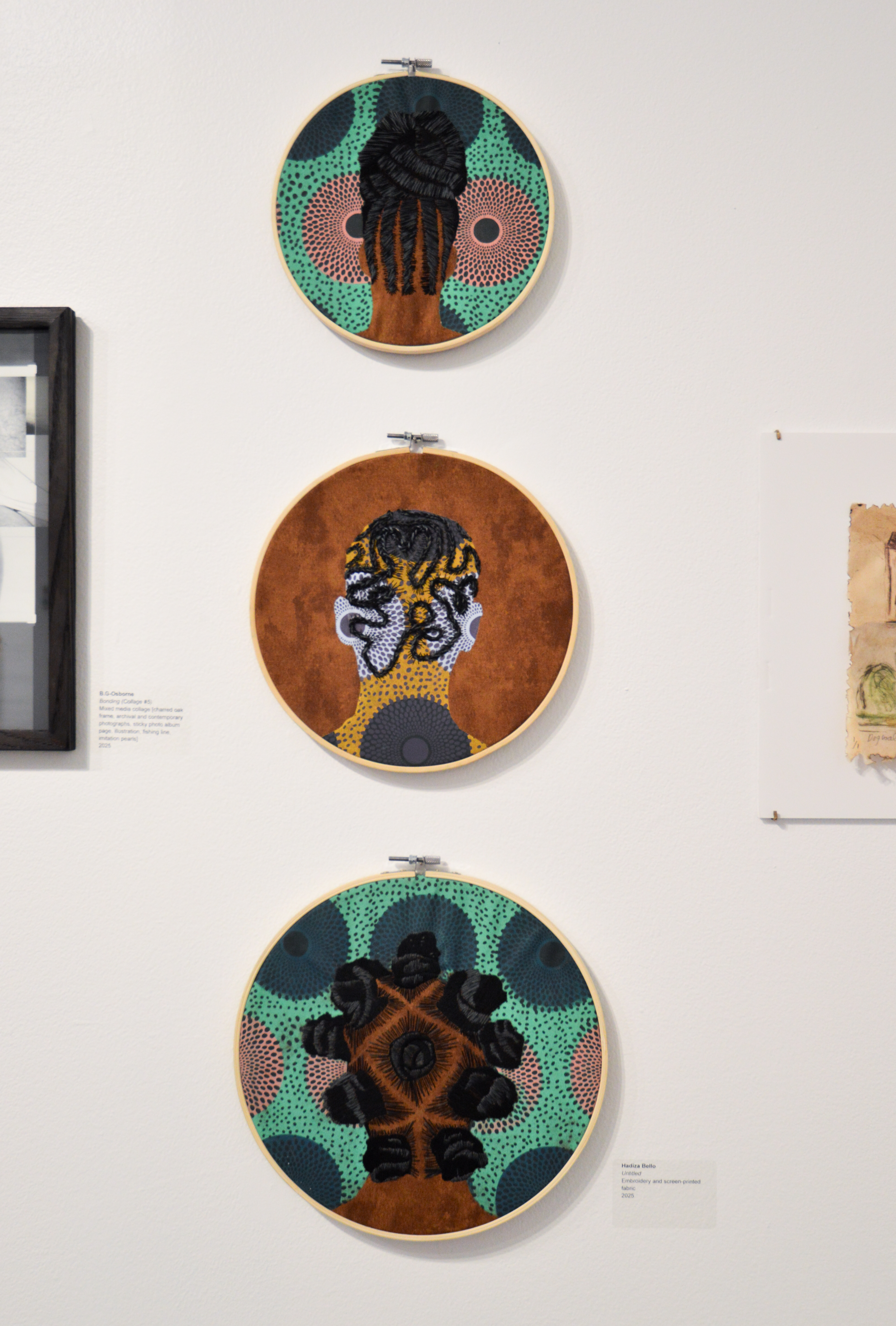
Hadiza Bello, Our Crowns (install view), 2025.
Embroidery floss on screen-printed fabric, 8, 9, and 10-inch hoops.
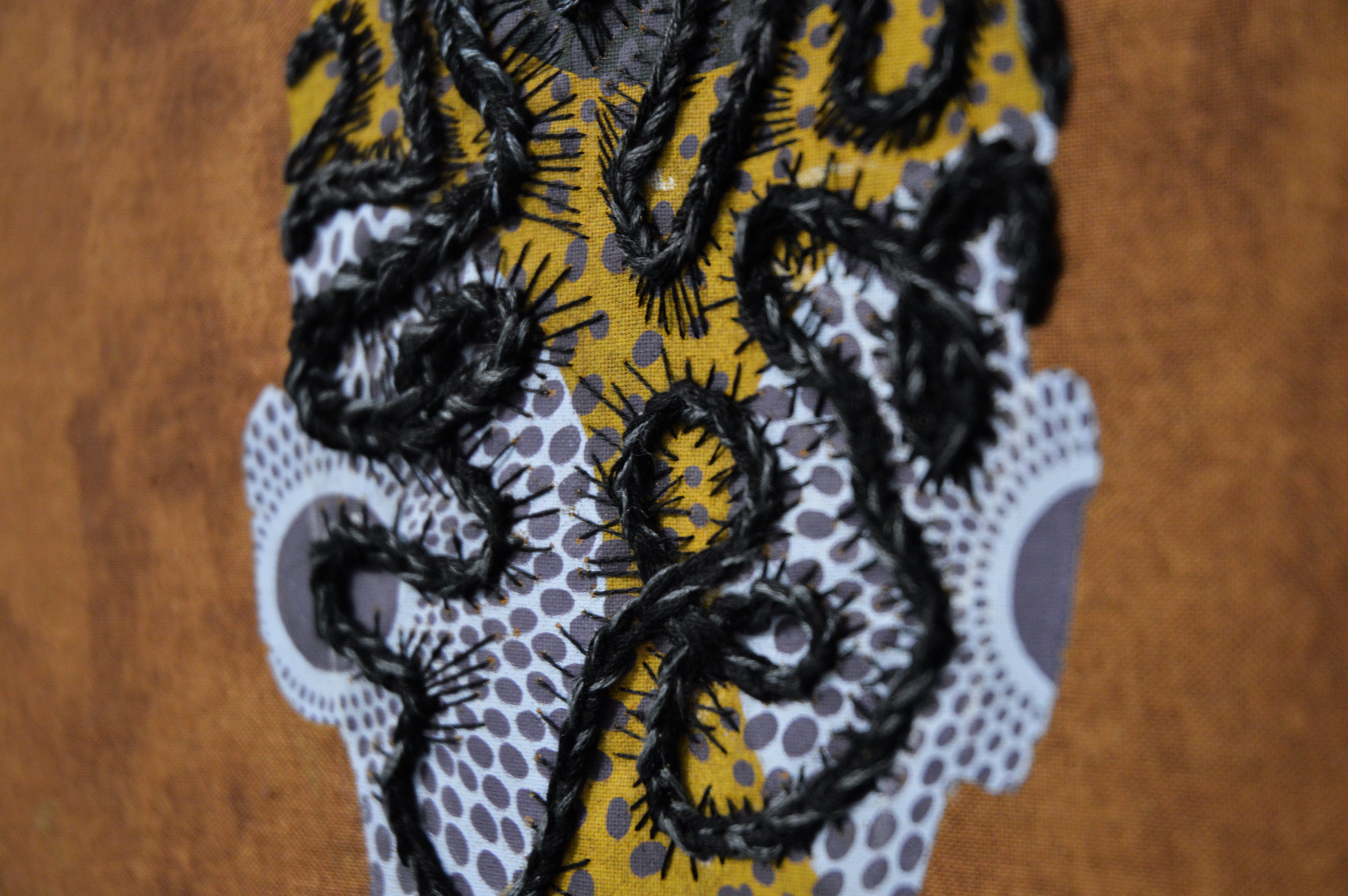
Hadiza Bello, Our Crowns (detail), 2025.
Embroidery floss on screen-printed fabric.
In Our Crowns, Bello works with textiles and embroidery hoops that each frame the back of a Black woman’s head, with hairstyles rendered in raised embroidery floss on screen-printed Ankara. The representations of twisted braids, loose, swirling locs, and large spiral curls hover between the figurative and the geometric.
The back of the head is rarely the focus of formal portraiture. Yet Bello frames each woman as worthy of close, unhurried attention — the intricate patterning of cornrows, the precise architecture of a twist-out. The triptych functions as a chorus of women and styles, yet with the same devotional significance: braiding hair is a ritual. Bello evokes this by depicting the back of a head as a crown.
Bello has described her practice as driven by the desire to represent Black people “in ways they have not traditionally, historically, or currently been viewed, and to depict them as they wish to be represented.” This is not merely representation as inclusion; it is representation as a claim. Her work, she says, serves her community as “a declaration of presence, an assertion that we are also entitled to take up space and be seen in all our complexity.” Bello’s work holds that complexity without apology, in art as in life, in the weight of braids gathered in a hand, in the particular hold of a stare. Bello is not asking to be included in a tradition. She is remaking it.